How to Measure Arm Length for a Dress Shirt (and Convert It to Sleeve Size)
By Liaqat Ali Nawaz
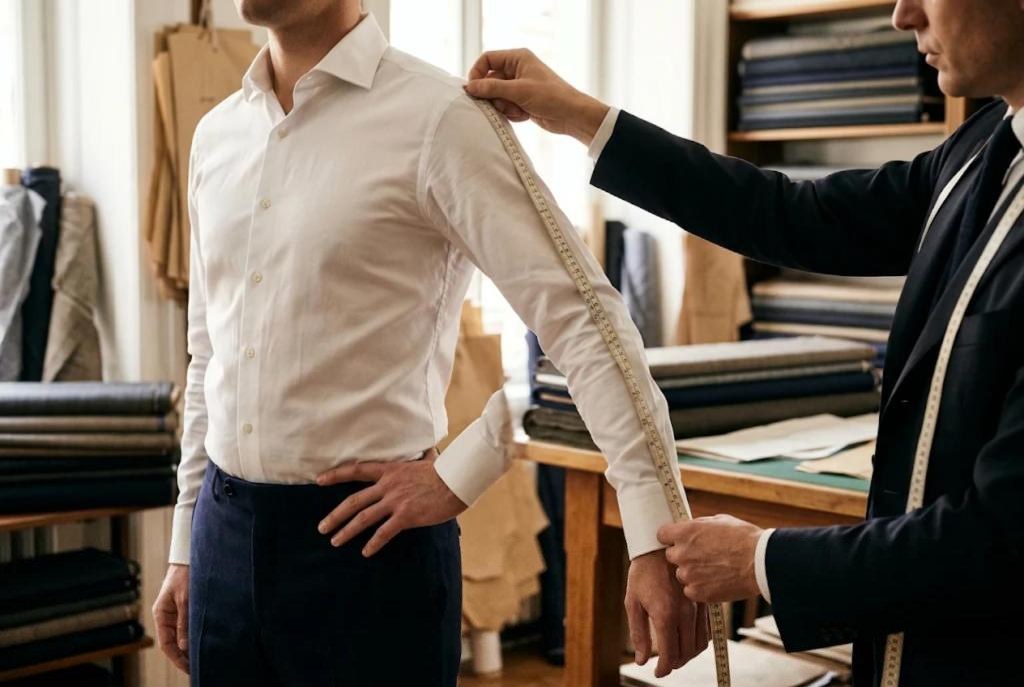
Arm length and dress shirt sleeve length are not the same number, and mixing them up is the most common reason a new shirt's cuffs end halfway up the wrist. This guide shows you how to measure your arm length correctly, alone or with a helper, and how to turn it into the sleeve size you need for a dress shirt.
We make every shirt to the customer's own measurements, so we see the results of good and bad arm measurements every week. Everything below is the method we ask our own customers to use.
Arm Length vs Sleeve Length: The Difference That Matters
Arm length is measured on your body from the shoulder point (the bony tip at the outer edge of your shoulder) to your wrist. Dress shirt sleeve length starts higher up: at the center back of your neck. It runs across your shoulder to that same shoulder point and then down the arm to the wrist.
| Starts at | Ends at | Typical adult man | |
|---|---|---|---|
| Arm length | Shoulder point | Wrist bone | About 23"–27" |
| Dress shirt sleeve length | Center back of neck | Wrist bone | About 32"–36" |
So the simple rule is:
Dress shirt sleeve length ≈ arm length + half your shoulder width
If your arm length is 25" and your shoulders measure 18" across the back, your dress shirt sleeve is about 25 + 9 = 34". That is the number to look for on a shirt label such as 16/34.
What You Need
- A soft tailor's tape (not a metal tape)
- A thin T-shirt or a well-fitting shirt, so the tape sits close to your body
- A helper if possible. If you are on your own, a mirror and a strip of masking tape
How to Measure Arm Length With a Helper (Most Accurate)
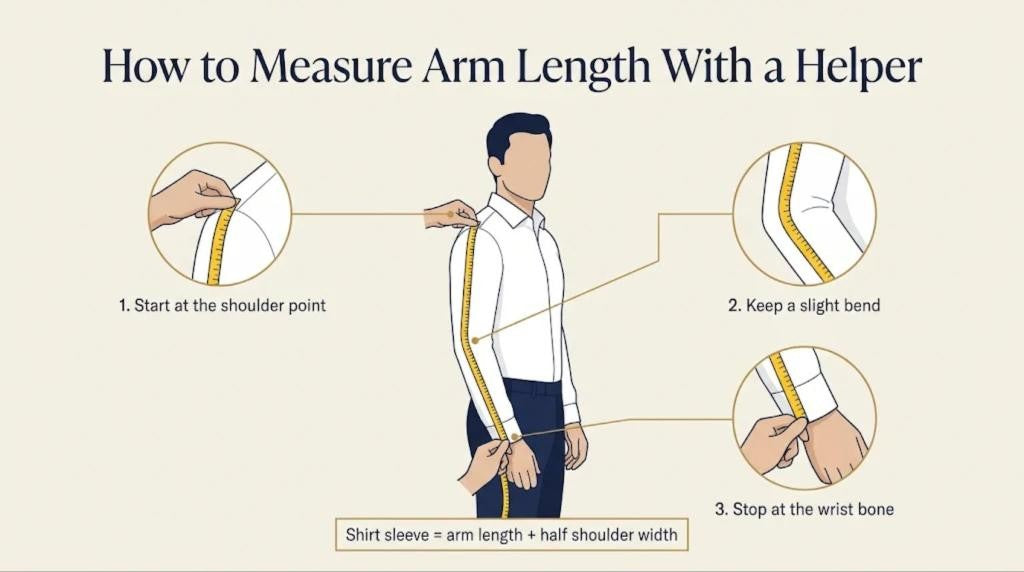
- Stand naturally. Feet hip-width apart, shoulders relaxed. Do not stand to attention, which lifts the shoulders and shortens the reading.
- Bend the elbow slightly. Rest your hand on your hip or let it hang with a small bend at the elbow. A straight, locked arm reads short, and a shirt cut to it will ride up the moment you reach for something.
- Find the shoulder point. Your helper feels along the top of your shoulder to the bony tip at the outside edge. That is where a shirt's shoulder seam should sit.
- Measure down the outside of the arm. The tape goes from the shoulder point, over the back of the elbow, to the wrist. Keep it against the arm, not floating in the air.
- Stop at the wrist bone. The end point is the small bony bump on the outside of the wrist (the little-finger side), where your wrist meets your hand. This is where a dress shirt cuff should end.
- Record and repeat. Write the number to the nearest quarter inch, then measure the other arm. Measure each arm twice.
How to Measure Arm Length by Yourself
Measuring alone is harder because the tape slips at the shoulder. The masking tape method fixes that:
- Stand in front of a mirror and find your shoulder point with your opposite hand.
- Stick a small piece of masking tape on your T-shirt right on that point.
- Hook or hold the end of the tape measure on the masking tape. A clothes peg on the shirt also works.
- Bend your elbow slightly, run the tape down the outside of your arm, and pinch it at the wrist bone.
- Read the number in the mirror, then repeat twice and use the average.
Short on time? Measure a shirt that already fits you well instead. Lay it flat, start at the center back of the collar, go across to the shoulder seam and down to the end of the cuff. That gives you the sleeve length directly. Our full measuring guide covers the other shirt measurements too.
Don't Forget Shoulder Width
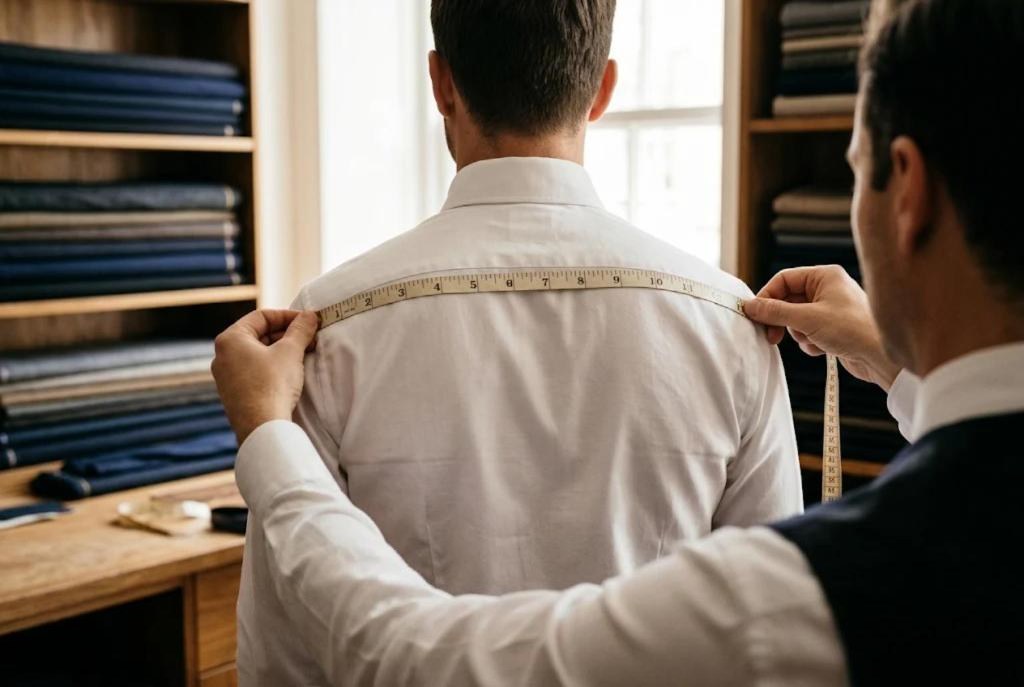
To convert arm length into a shirt sleeve you need your shoulder width. Ask your helper to measure across your back from one shoulder point to the other, following the curve of the upper back. Halve it and add it to your arm length.
Arm Length to Dress Shirt Sleeve Chart
Use this as a check on your own numbers. Find your arm length on the left and your shoulder width along the top.
| Arm length | Shoulders 17" | Shoulders 18" | Shoulders 19" | Shoulders 20" |
|---|---|---|---|---|
| 23" | 31.5" | 32" | 32.5" | 33" |
| 24" | 32.5" | 33" | 33.5" | 34" |
| 25" | 33.5" | 34" | 34.5" | 35" |
| 26" | 34.5" | 35" | 35.5" | 36" |
| 27" | 35.5" | 36" | 36.5" | 37" |
Round to the nearest half inch. If you land on a half size, for example 34.5", a 34/35 shirt is the closest ready-to-wear fit, and a custom shirt can be cut to exactly 34.5".
Can You Guess Arm Length From Height?
Only roughly. Taller men usually have longer arms, but two men of the same height can differ by an inch or more in arm length, and shoulder width varies even more. Use height only to sanity-check your tape measure: if you are 5'9" and your shirt sleeve works out at 38", measure again. For most men between 5'6" and 6'3", dress shirt sleeves fall between 32" and 36".
7 Arm Measuring Mistakes (and How to Avoid Them)
- Using arm length as your shirt size. A 25" arm is not a 25" sleeve. Add half your shoulder width.
- Measuring with a straight, locked arm. Always keep a slight bend at the elbow.
- Starting at the top of the shoulder near the neck. Arm length starts at the outer shoulder point, not the top of the shoulder.
- Stopping at the palm or the hand. Stop at the wrist bone. A sleeve cut to your palm will look too long and bunch.
- Measuring over a thick jumper. Bulky clothing can add half an inch or more.
- Measuring one arm only. Arms often differ slightly. Use the longer arm, so the shorter one has a touch of extra length rather than the long one being short.
- Measuring once. Measure twice and average. If the readings differ by more than half an inch, measure a third time.
How Long Should a Dress Shirt Sleeve Be When You Wear It?
With your arms relaxed, the cuff should end at the wrist bone, where the hand begins. When you wear a jacket, about a quarter to half an inch of shirt cuff should show below the jacket sleeve. When you reach forward, the cuff should not slide far up your forearm. If you wear a watch, the cuff on that wrist should sit over it without catching; some men ask for that cuff to be slightly wider.
Get Sleeves That Fit Every Time
Off-the-rack shirts come in two-inch sleeve ranges and a few fixed shoulder widths, so they rarely match both your arm and your shoulders. Our custom dress shirts are cut to your exact arm length, shoulder width, neck and chest, then made in 5–6 working days. Browse our business dress shirts or wedding and black tie shirts, and check the size guide if you need help with any measurement.
Frequently Asked Questions
How do you measure arm length for a dress shirt?
With your arm slightly bent, measure from the bony tip of your shoulder down the outside of your arm, over the elbow, to the wrist bone. Then add half your shoulder width to get your dress shirt sleeve length.
Is arm length the same as sleeve length?
No. Arm length starts at the shoulder point. Dress shirt sleeve length starts at the center back of the neck, so it is longer by about half your shoulder width, usually 8.5" to 10".
Should my arm be straight or bent when measuring?
Slightly bent. A straight arm reads short, and the cuffs will pull up when you move.
Where exactly on the wrist should I stop?
At the wrist bone on the outer (little-finger) side, where your wrist meets your hand. That is where a dress shirt cuff should end.
What if my arms are different lengths?
That is common. Use the longer arm for a ready-made shirt. For a custom shirt, add both numbers in your order note so we can see the difference before cutting.
What is the average arm length for a man?
Most adult men measure roughly 23" to 27" from shoulder point to wrist, which works out to a dress shirt sleeve of about 32" to 36". Your own measurement is always more reliable than an average.